
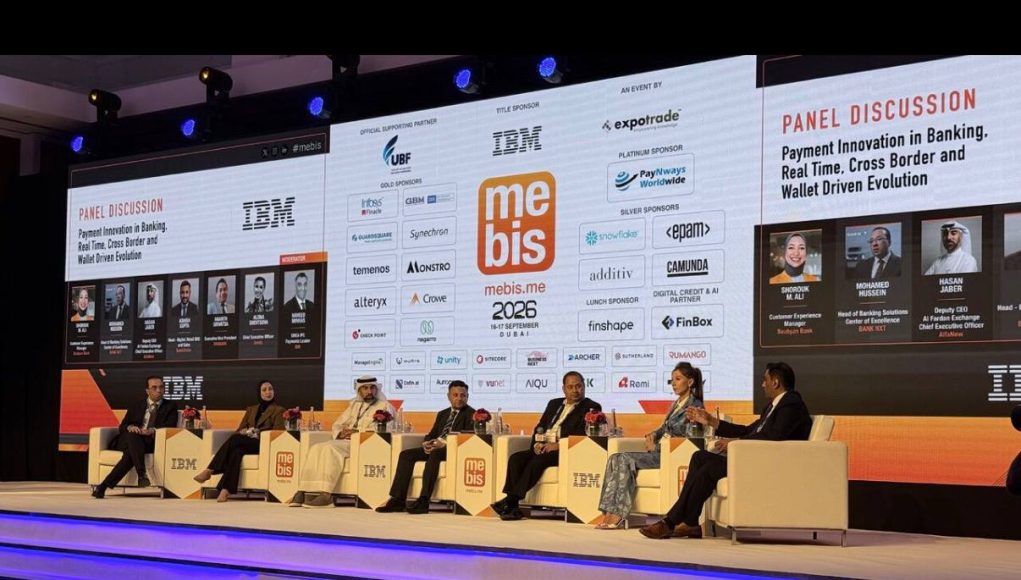
Real-time payments. Cross-border infrastructure. Digital wallets. These aren’t just talking points anymore — they’re reshaping how money moves globally, and the people setting the agenda gathered in Dubai on 17 September to hash it all out.
That’s where Alona Shevtsova, CEO of Sends, joined senior executives from across the banking and fintech world at the 17th edition of the Middle East Banking Innovation Summit (MEBIS 2026), held at Jumeirah Emirates Towers. Her panel — “Payment Innovation in Banking: Real Time, Cross Border and Wallet Driven Evolution” — tackled exactly the questions the industry can’t stop asking.
She wasn’t alone up there. The discussion brought together Hasan Jaber, Deputy CEO at Al Fardan Exchange and CEO of AlfaNow; Ananth Srivatsa, Executive Vice President at RAKBANK; Mohamed Hussein, Head of Banking Solutions Center of Excellence at BANK NXT; Kamran Khan, Executive Director of Product Innovation & Implementation (EMEA) at First Abu Dhabi Bank; Ashish Gupta, Head of Digital, Retail SME and Sales at BankDhofar; and Naveed Minhas, EMEA IPC Payments Leader at IBM.
Heavy hitters, all of them.
The panel went deep on where financial institutions are already extracting real value from real-time payments, how connected digital wallets are rewriting customer expectations, and — the thorny bit — what’s still blocking cross-border payments from being genuinely fast and efficient. Not aspirationally fast. Actually fast.
Interoperability kept surfacing as the central challenge. As payments cut across platforms, currencies, and jurisdictions faster than ever, banks and fintechs face a real tension: connecting old-school banking infrastructure to new payment rails without sacrificing security, compliance, or day-to-day operational stability. Easier said than done.
Alona Shevtsova put it plainly from the panel:
“The future of payments will not be defined by a single technology or payment method. The real opportunity is in connecting the ecosystem around the customer. Real-time payments, wallets and cross-border infrastructure need to work together so that moving money becomes simpler for the user, while the technology, compliance and risk infrastructure behind that experience continues to evolve.”
Worth sitting with that. It’s not a pitch — it’s a diagnosis.
MEBIS isn’t her first conference circuit stop in 2026, either. Earlier this year, Alona Shevtsova joined expert panels at PAY360 in London, covering agentic AI in AML and KYC alongside the evolution of embedded finance. She also participated in discussions in Riyadh, where the agenda zeroed in on AI, risk, blockchain, and digital finance.
The Dubai appearance fits a pattern. Sends — the UK-based fintech she leads — is increasingly active in Middle East conversations as the region keeps pouring investment into real-time payment infrastructure, digital banking, and fresh models for cross-border financial services. The timing isn’t accidental.
MEBIS itself draws C-level banking executives, technology leaders, and operators from across the Middle East. The 2026 programme covered AI and intelligent automation, digital banking, payments innovation, open banking, embedded finance, cybersecurity, data strategy, and next-generation financial infrastructure. Dense agenda. Serious room.
The questions the panel wrestled with in Dubai aren’t going away. If anything, they’re getting harder — and louder.